What corporate stationery typically includes
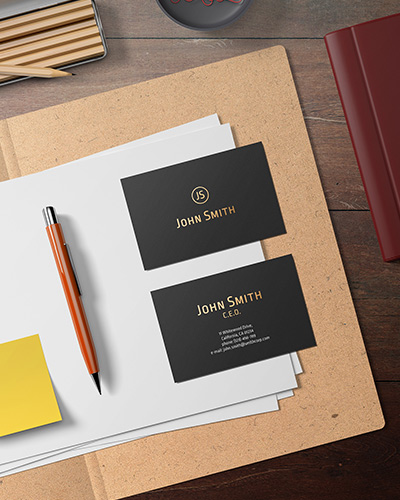
When a Singapore office requests corporate stationery from a printer, the requirements typically extend beyond just a single letterhead. A standard set usually includes letterheads, second sheets, DL and C4 envelopes, compliment slips, presentation folders, and business cards that accompany them.
People searching for corporate stationery printing or company letterhead printing in Singapore often come with a logo file and little else. This is sufficient to initiate a conversation, but the printer still needs specific details such as the stock, colour intent, finish, and file setup before anything goes to press. Getting these four elements right ensures the rest of the process is routine.
Paper weight and stock, expressed in plain numbers
Paper is quoted in GSM, grams per square metre, which is simply how heavy one square metre of the sheet is. Higher GSM feels thicker and stiffer. A common question, what GSM for letterhead, has a practical answer: 100 to 120gsm uncoated woodfree paper prints cleanly and still runs through an office laser printer if staff need to add variable text later. Go heavier only when the letterhead is a presentation piece that will never be reprinted in-house.
Business cards are on the opposite end of the spectrum. Anything below 300gsm feels too flimsy to hold, so the sensible range is between 300 to 350gsm. Going up to 400gsm or using a duplexed board gives a premium feel. Presentation folders, which hold weight, should be made of 250 to 300gsm coated board to prevent sagging when documents are inside. Envelopes typically range from 100 to 120gsm; if the envelope has a printed reverse or a heavy solid, opt for a slightly heavier wove so the ink does not show through.
| Item | Typical stock | Weight range |
|---|---|---|
| Letterhead and second sheet | Uncoated woodfree | 100 to 120gsm |
| Business or name card | Coated or uncoated board | 300 to 400gsm |
| Compliment slip | Uncoated woodfree | 100 to 120gsm |
| Presentation folder | Coated board | 250 to 300gsm |
| DL and C4 envelope | Wove | 100 to 120gsm |
One decision ties the set together: coated or uncoated. Coated stock (matte or gloss) holds sharp colour and photographic detail. Uncoated stock takes a pen and a rubber stamp, which matters for letterheads that get signed or annotated. Many companies keep the writing pieces uncoated and reserve coated board for cards and folders. State the choice per item so nothing is guessed at quotation.
Colour options include CMYK and Pantone, while ensuring consistency with the brand.
Digital and litho presses build most colours from four process inks, cyan, magenta, yellow and black, which is where the term CMYK comes from. A brand colour reproduced this way can drift slightly from press to press, which is the usual reason a reprint looks a shade off. If your identity depends on an exact colour, specify it as a Pantone (spot) reference and ask the printer to run it as a spot ink or to match against a physical swatch. That is the honest answer to the frequent search, why does my printed blue look different from my screen: screens emit light in RGB, paper reflects it in CMYK, and the two gamuts do not fully overlap.
Two habits prevent most colour complaints. Supply artwork already converted to CMYK rather than RGB, and note any Pantone values in the file and the order. For a deeper look at holding colour steady over repeated orders, our note on branded corporate stationery standards sets out how to lock this down across a rollout.
Finishes and coatings
Finishing touches can significantly impact how a piece feels and how long it survives handling. Lamination is a popular choice for cards and folders, and the matte versus gloss choice often arises with nearly every order. Matte lamination provides a soft, understated appearance, whereas gloss enhances colors and photos but attracts fingerprints more easily. In addition to lamination, several finishes justify their cost on the right piece:
- Spot UV is a clear, raised gloss applied over a logo or line of text on an otherwise matte card. This technique creates a striking contrast that you can feel.
- Soft-touch lamination is a velvety coating that makes a 350gsm board feel even heavier than its actual weight.
- Foil stamping involves pressing a metallic or colored foil into the stock. This technique is used sparingly on premium cards and folders.
- Rounded corners and edge painting are small details that make a card stand out in a stack.
Finishing processes add time and setup costs, so it's important to decide early. For example, a folder that requires a die-cut business card slit, gloss lamination, and a spot UV logo involves three separate operations. Each of these operations should be included in the initial quote to ensure accurate costing.
Building a print-ready file
Most reprints and delays are often due to issues with the file rather than problems with the printing press. The good news is that creating a print-ready PDF for corporate stationery involves a short checklist that rarely changes.
Bleed, trim, and safe margin
Bleed is artwork extended past the final cut line, usually 3mm on every edge, so that a slight shift on the guillotine never leaves a white sliver. The trim line is where the sheet is actually cut. The safe margin sits about 3 to 5mm inside the trim, and text or logos should stay within it so nothing important gets clipped. A card designed to the exact finished size with no bleed is the single most common problem file a Singapore printer sees.
Fonts, resolution, and file format
Embed or outline every font to ensure a substitute typeface never appears in print. Place images at 300 dpi at their final size; a logo pulled from a website at 72 dpi will appear soft when printed. Export files to PDF, and if the printer supports it, use the PDF/X standard. This standard flattens transparency and enforces CMYK color space to ensure the file behaves consistently on both your system and the printer's. Keep a separate high-resolution vector file of the logo on hand, as it will likely be needed again for the next item in the set.
Ordering corporate stationery online in Singapore
Once the specs are settled, ordering is the easy part. Our custom and online printing service lets you upload finished artwork, choose stock and finish from the same specification you have just built, and see a soft proof before anything prints. If you are searching for where to upload artwork for online printing in Singapore or how to order a full stationery set in one go, this is the route that keeps every item on the same paper and colour.
For a first order, ask for a physical proof of the business card and letterhead. A screen proof confirms layout, but only paper in hand confirms the stock feel and the colour under office light. It is a small step that settles most of the questions that would otherwise surface after the full run. You can browse the wider range through our general printing services if the brief grows to include booklets or posters.
Making reorders painless
Corporate stationery is rarely a one-time job. Business cards run out, a new hire joins, a department moves floors. The buyers who avoid repeated back-and-forth store their approved specs and artwork with the printer so a reorder is a single line of instruction rather than a fresh brief. Setting that up is straightforward, and our guide to setting up a corporate print account explains how repeat orders, approvals and billing sit together.
If you want a spec sheet reviewed before you commit to a run, send the files and a short note about quantities through our contact page, or read more about how we work on the about page. A ten-minute check of bleed, colour mode and stock choice is the cheapest insurance a print budget can buy.